I Tried To Think My Way Out For Two Years
I believed that if I ran the argument one more time it would finally resolve. Two years of that. Here is what it cost, and the small stupid thing that broke the loop.
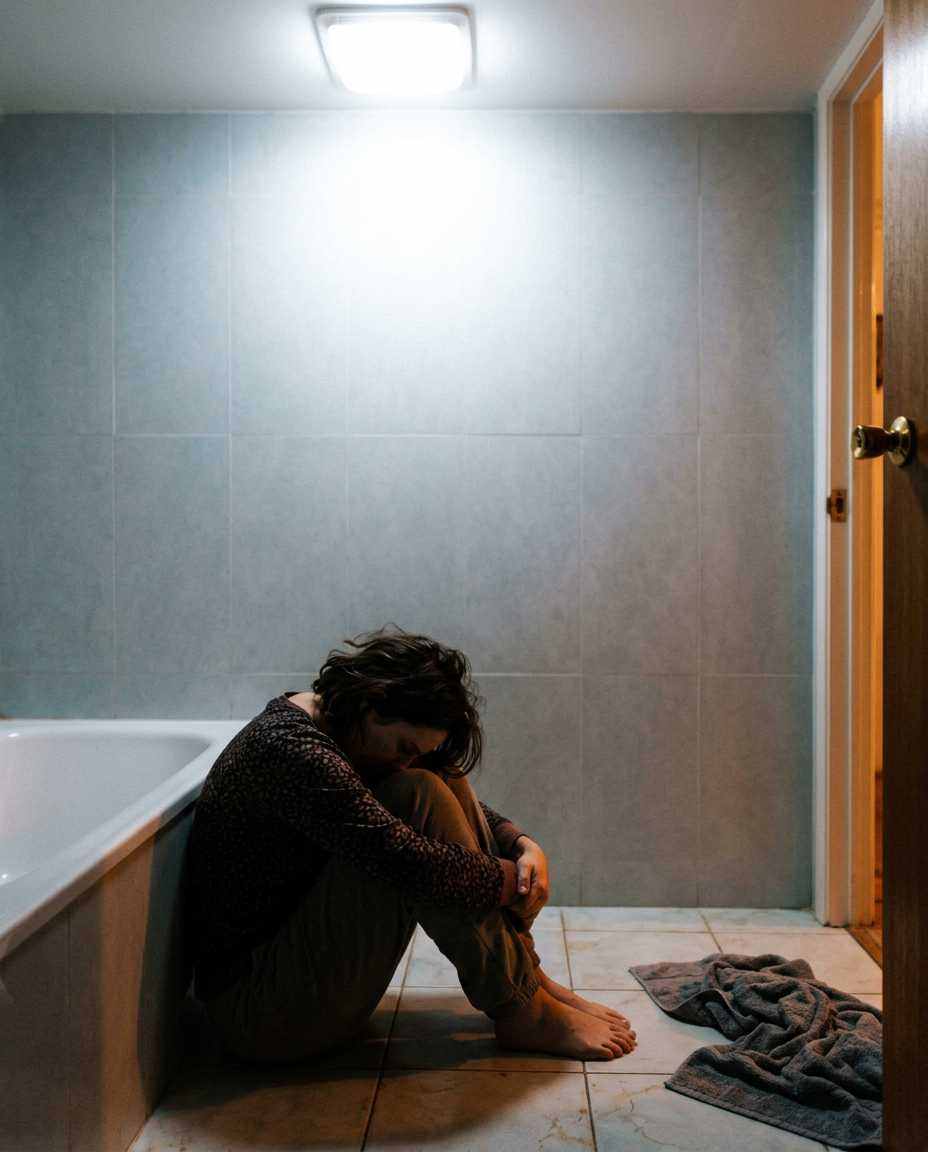
A little past one in the morning and you are on the bathroom floor with your back against the tub, because the bed is where the thinking is worst and the tile at least has a temperature. Third night this week.
You are running the same argument again. Sixth time, better lines tonight, and you are almost sure that this time it reaches the end and you sleep.
That was me for about two years. I want to put a number on what it cost, because nobody put one on it for me.
What I Did Instead
Instead of standing up, I thought harder.
That was the whole strategy. Every time the thinking failed, my conclusion was that I had not thought enough yet, so I went around again. On the floor, in the bath, in the car outside my building with the engine off, and for most of year two, in bed from midnight to four.
The bill: most of my sleep for two years, and a tired that sleep does not touch, because you did not do anything all day. You operated a machine.
Why It Felt Right
Because rumination does a very good impression of problem-solving.
Same opening move: here is a thing that is wrong, let us understand it. It never reaches the part where you do something. Nothing else at that hour feels so much like effort while producing nothing.
Susan Nolen-Hoeksema spent a career on this. Her 2008 review with Wisco and Lyubomirsky in Perspectives on Psychological Science found that rumination does not merely fail to solve the problem: across the work they collected, it travelled with worse problem-solving and less action taken. It is a review, not a trial. Some of what it gathers is correlational; some of it comes from experiments that induced rumination on purpose and watched problem-solving get worse. Better than a hunch, short of a law. The review is here.
But it named the thing. I was not bad at thinking. The format was the problem, and doing more of it was doing more of the format.
What Changed
I stood up and went outside.
That is the whole turn, and it is humiliating: I shopped for an insight for two years and the answer was leaving the room. Here are the two studies behind that, and how small they actually are.
The walk one
Gregory Bratman and colleagues at Stanford published it in PNAS in 2015. Thirty-eight people. Half took a 90-minute walk through a green space, half took a 90-minute walk beside a busy road. The nature group came back reporting less rumination, with less activity in the brain region the researchers were watching. The road group moved on neither measure. Paper here.
Now the oversell. Thirty-eight people, one afternoon, one walk: a hint, not a law. And the comparison was a nature walk against a city walk. Nobody in that study stayed home, so it cannot tell you that walking beats sitting on the bathroom floor. And the detail that should have stopped me: every one of those thirty-eight was screened to have no current or past psychiatric diagnosis, average age twenty-six. The study deliberately excluded people in the state I was in. When you see "nature rewires your brain" on a slide, that is a 38-person afternoon in a costume.
The acting-first one
The bigger one is about a treatment, not a walk. Behavioural activation is the therapy built on doing the thing first and letting the wanting-to arrive later, if ever. David Richards and colleagues ran the COBRA trial on 440 adults, published in The Lancet in 2016, following them for a year. Delivered by junior mental health workers with no professional psychotherapy training, trained in this one method and supervised through it, it came out no worse than CBT from experienced therapists. The gap at twelve months was 0.1 points on a nine-question depression questionnaire, with the uncertainty around that gap running from -1.3 to 1.5. Paper here.
What never survives into the summary: nobody got fixed. Both groups started around 17 on that questionnaire and sat around 8 a year later. Real drop, not a cure.
And this one costs me the punchline. COBRA studied structured therapy with a trained person, over months, not going for a walk. I cannot hand you its 440 people as backup for my bathroom floor. It says the act-first approach is serious and held up in a large trial. It does not say a walk is therapy.
One Person
The walk did not resolve the argument, and I resented every version of this story that skipped that. The argument was waiting when I got back.
What changed is that it had been interrupted, and after enough interruptions it stopped feeling like something I was in the middle of and started feeling like something I could put down. Nobody claps for this part.
It worked for me. I'm one person, and one is not a study.
Tonight
Do not try to finish the thought. Two years of my life is the evidence that the trying is the trap.
Put shoes on, walk to the end of your street, come back. Ten minutes. That is the whole of what I have.
The sixth loop at one in the morning does not resolve on the seventh. Leaving the room was the one move I had that was not the loop.
Not for
This is for a bad night. It is not for a diagnosis, and I'm not the person for that one. If this is every night and not just tonight, that is a conversation with a person, not a blog post. If you are on something that works, keep taking it. Nothing on this page replaces it.
If tonight is worse than a bad night: in the US, call or text 988. It is free and it is not an overreaction.
More from Wilder Brain
The 3 A.M. File
Five things I do when I wake at three and my brain has already picked the worst memory it owns, in order, and honest about how little any of them do.
Task Aversiveness, In Bar Language
The real predictor of procrastination has a clinical name and nothing to do with being lazy. Here is the number behind the word, and the one thing that actually moves it.
Cortisol, In Bar Language
Everyone online is selling a way to lower it. Here's what it actually is, why yours is supposed to spike at dawn, and the short list of things that really move it.